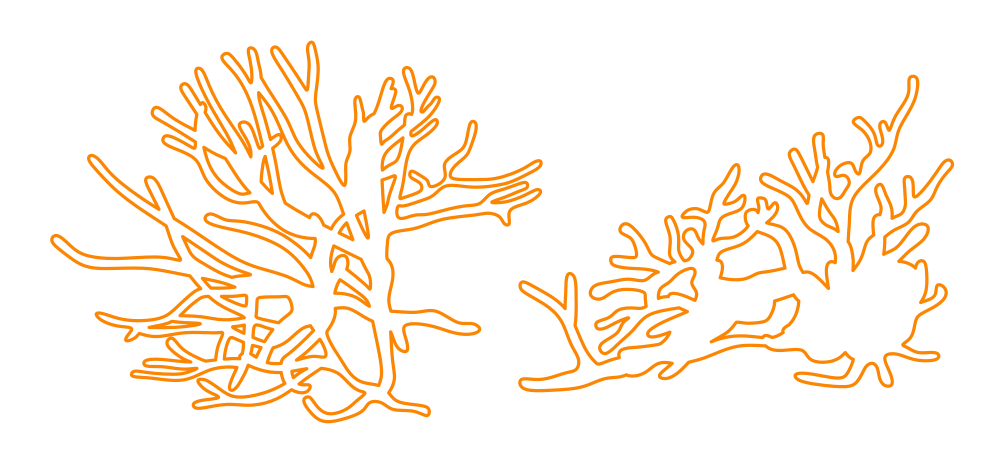
The Freshwater sponge (Spongilla lacustris) prefers shallow, clear waters, in ponds, lakes, or slow-moving water bodies in Europe, Asia, and North America. This is the most widespread sponge in the inland waters of Europe. This dominance is mostly seen during Winter. Depending on the habitat, the freshwater sponge can be branched, digitated, or encrusting. It produces sexually or asexually and feeds on small organic animals floating in the water. Freshwater sponges can be white or green. These invertebrates attach themselves to streambed rocks and resemble algae. However, it is their soft texture that separates them from algae.
The Freshwater Sponge has an overall cluster diameter between 13.8”-21.7” (35-55 cm) and height of 11.8”-17.7” (30-45 cm). The diameters of the individual stalks are typically between .31”-.47” (.8-1.2 cm).

The Freshwater sponge (Spongilla lacustris) prefers shallow, clear waters, in ponds, lakes, or slow-moving water bodies in Europe, Asia, and North America. This is the most widespread sponge in the inland waters of Europe. This dominance is mostly seen during Winter. Depending on the habitat, the freshwater sponge can be branched, digitated, or encrusting. It produces sexually or asexually and feeds on small organic animals floating in the water. Freshwater sponges can be white or green. These invertebrates attach themselves to streambed rocks and resemble algae. However, it is their soft texture that separates them from algae.
The Freshwater Sponge has an overall cluster diameter between 13.8”-21.7” (35-55 cm) and height of 11.8”-17.7” (30-45 cm). The diameters of the individual stalks are typically between .31”-.47” (.8-1.2 cm).