The Tundra Swan (Cygnus columbianus) is a Holarctic swan, and the smallest swan that occupies this biogeographic region. They live in shallow pools, lakes, and rivers in the arctic and subarctic tundra, and in the winter they migrate to grasslands and marshlands near the coast. In adults the plumage is entirely white; other physical characteristics include black feet, a black bill with a thin salmon-pink streak that runs along the mouth, and dark brown irises. They have a high-pitched honking call, and they are especially vocal when foraging in flocks. They forage for their food, mainly aquatic vegetation like mannagrass, pondweeds, and marine eelgrass.
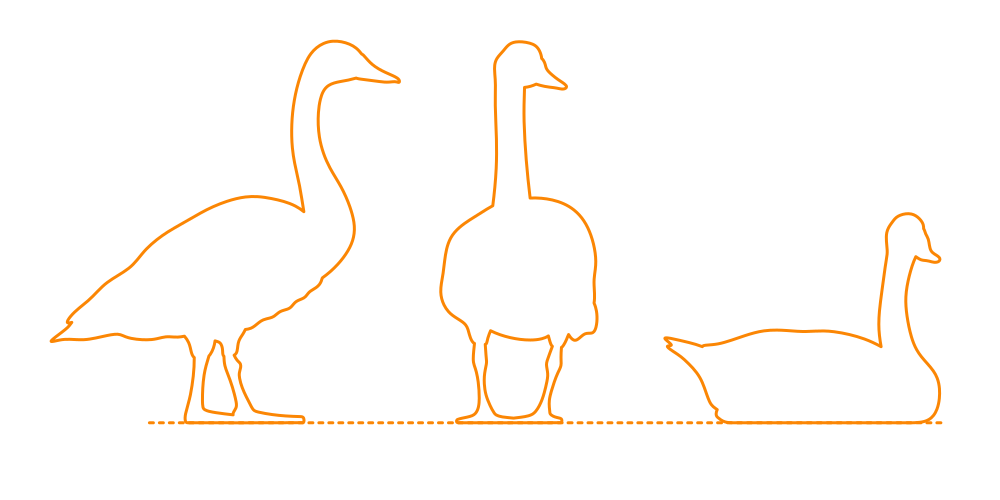
The Tundra Swan has a wingspan in the range of 72”-84” (183-213 cm) and total weight of 7.5-21.2 lb (3.4-9.6 kg). The body of the Tundra Swan has an overall length between 45.3”-59.1” (115-150 cm), body width of 11.8”-15.75” (30-40 cm), and standing height of roughly 29.5”-37.8” (75-96 cm). The typical lifespan of the Tundra Swan is between 15-24 years.

The Tundra Swan (Cygnus columbianus) is a Holarctic swan, and the smallest swan that occupies this biogeographic region. They live in shallow pools, lakes, and rivers in the arctic and subarctic tundra, and in the winter they migrate to grasslands and marshlands near the coast. In adults the plumage is entirely white; other physical characteristics include black feet, a black bill with a thin salmon-pink streak that runs along the mouth, and dark brown irises. They have a high-pitched honking call, and they are especially vocal when foraging in flocks. They forage for their food, mainly aquatic vegetation like mannagrass, pondweeds, and marine eelgrass.
The Tundra Swan has a wingspan in the range of 72”-84” (183-213 cm) and total weight of 7.5-21.2 lb (3.4-9.6 kg). The body of the Tundra Swan has an overall length between 45.3”-59.1” (115-150 cm), body width of 11.8”-15.75” (30-40 cm), and standing height of roughly 29.5”-37.8” (75-96 cm). The typical lifespan of the Tundra Swan is between 15-24 years.