
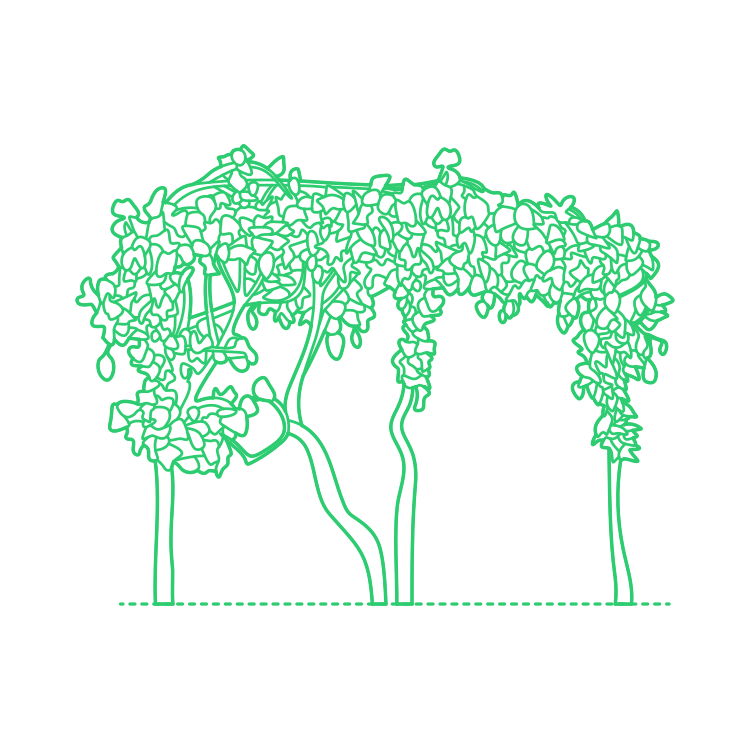
Fruit-bearing vines are climbing or trailing plants that develop edible fruits as part of their reproductive cycle. These vines often grow in temperate to tropical climates, where their climbing habit allows them to access sunlight by attaching to structures or nearby plants. Originating in diverse ecosystems across the globe, their evolution has favored flexible stems and efficient vertical growth, enabling them to thrive in dense vegetation.
Over time, fruit-bearing vines have adapted to a wide range of habitats—from forest edges and riverbanks to cultivated gardens and orchards. Their natural strategy involves rapid growth and fruit production to attract animals that disperse seeds. Many species are perennial, returning year after year, while others complete their cycle within a single season. With minimal space requirements and vigorous growth, these vines are well-suited for small-scale agriculture, home gardens, and trellised landscapes, contributing both greenery and harvestable produce to cultivated environments.
Fruit-bearing vines grow with long, flexible stems that either sprawl across the ground or climb using tendrils, twining stems, or sticky pads. Their leaves are often broad and arranged alternately along the stem, helping absorb sunlight for energy. These vines produce flowers that later develop into fruits, which carry seeds for reproduction. Some vines grow quickly, spreading in all directions, while others are more controlled in their growth. Roots are usually shallow but wide-reaching, anchoring the plant and drawing in nutrients.
Many species use tendrils—thin, curling structures—to grip nearby surfaces or supports. Fruits may grow singly or in clusters and can vary widely in shape, color, and texture. Depending on the species, the vine may produce fruit seasonally or throughout the year. Growth can be annual or perennial, and seeds often germinate easily, allowing new plants to form rapidly in suitable conditions.
Throughout history, fruit-bearing vines have held practical and symbolic importance across many cultures. Grapevines, for example, have been central to rituals, agriculture, and economies since ancient times, celebrated in art, mythology, and religion. In daily life, these vines offer nourishment and flavor—grapes, kiwis, passionfruit, and more are widely consumed fresh, dried, or processed. Their ability to grow vertically makes them ideal for small spaces and backyard gardens, providing beauty alongside bounty.
Professionally, vineyards and orchards support global industries in winemaking, farming, and export. In warm climates, they are often trained over arbors and trellises, blending productivity with decorative function. Stories, proverbs, and cultural traditions frequently feature climbing fruit vines as symbols of growth, abundance, and continuity. The long-standing relationship between humans and these plants continues to evolve, reinforcing connections to food, place, and heritage across generations and geographies.
Warm, temperate, and subtropical climates are generally most favorable for growing fruit-bearing vines, as these conditions provide the consistent sunlight, moderate rainfall, and long growing seasons many vine species require. Mediterranean regions and tropical zones also support excellent growth due to their mild winters and hot summers. However, some cold-hardy varieties can adapt to cooler climates with proper care and protection from frost.
Full sun exposure is typically ideal for most fruit-bearing vines, as it supports healthy growth and encourages maximum fruit production. These plants rely on sunlight to fuel photosynthesis, which helps them develop strong vines and an abundance of blossoms that mature into fruit. While some varieties tolerate partial shade, reduced sunlight often leads to fewer flowers, delayed ripening, and lower overall fruit yields.
Self-pollinating vines can produce fruit using pollen from their own flowers, meaning they don’t rely on another plant nearby for fertilization. Cross-pollinating vines, on the other hand, require pollen from a different plant of the same species to set fruit successfully. This process typically depends on external pollinators like bees or wind to transfer the pollen between plants, increasing genetic diversity.