

Search Results

A crib retaining wall is a gravity retaining structure, usually employed for soil stabilization and erosion control. It consists of interlocking boxes made from precast concrete or timber, forming a crib-like framework. This framework is then filled with granular material. Crib Retaining Walls are constructed with typical heights of 6’-20’ (1.83-6.1 m), overall depths of 2.5’-6.5’ (.76-1.98 m), and block heights between 8”-20” (20.3-50.8 cm). Crib Retaining Walls are often created at an angle of 10-20 degrees and structural spacings between 2.5’-6.5’ (.76-1.98 m). Retaining wall lengths vary as needed.

A gravity retaining wall is a structure designed to hold back soil or loose materials, preventing them from eroding or collapsing. It relies on its own weight to counteract the lateral forces exerted by the retained material. The wall's base is usually wider than the top. Gravity Retaining Walls are constructed with typical heights of 2’-16’ (.61-4.88 m), base depths of 1’-8’ (.3-2.44 m), and wall thicknesses between .5’-5’ (.15-1.52 m). Gravity Retaining Walls are often created at an angle of 6-12 degrees. Retaining wall lengths vary as needed.

A buttress retaining wall is an enhanced structural solution for holding back soil on sloped terrains. It consists of a vertical wall that’s reinforced with support elements, known as buttresses, which extend at right angles or are inclined from the face of the wall. Buttress Retaining Walls are constructed with typical heights of 4’-25’ (1.22-7.62 m), base depths of 2.5’-15’ (.76-4.57 m), and wall thicknesses between 8”-24” (20.1-61 cm). Buttress Retaining Walls are often created with an angle of 2-6 degrees and buttress spacings between 1.5’-11’ (.46-3.35 m). Retaining wall lengths vary as needed.

A counterfort retaining wall is designed for retaining large quantities of soil, particularly in tall structures. Similar to a cantilever retaining wall, it has a vertical face and horizontal base, but with additional vertical concrete webs called counterforts. Counterfort Retaining Walls are constructed with typical heights of 4’-25’ (1.22-7.62 m), base depths of 2.5’-15’ (.76-4.57 m), and wall thicknesses between 8”-24” (20.3-61 cm). Counterfort Retaining Walls are often created with an angle of 2-6 degrees and counterfort spacings between 1.5’-11’ (.46-3.35 m). Retaining wall lengths vary as needed.

An anchored retaining wall is a structure that employs anchoring cables or rods for added stability when holding back soil. These walls are often used in situations with limited space or where a high load is anticipated. The anchors are driven deep into the soil or rock behind the wall. Anchored Retaining Walls are constructed with typical heights of 6’-18’ (1.83-5.49 m) and wall depths of 8”-24” (20.1-61 cm). Retaining wall lengths vary as needed.

Retaining Walls are the types of walls that are rigidly designed and constructed to serve the function of supporting soil vertically so that it can be retained at different levels. Retaining Walls can effectively retain and support sloping soil that otherwise would not be able to naturally stay.

An L-Type cantilever retaining wall, also known as an L-wall, is a widely used retaining wall structure designed to hold back soil and maintain different ground levels. Its characteristic L-shape, consisting of a vertical stem and horizontal base slab. L-Type Cantilever Retaining Walls are constructed with typical heights of 3’-20’ (.91-6.1 m), base depths of 1.5’-10’ (.46-3.5 m), and wall thicknesses between 4”-12” (10.2-30.5 cm). L-Type Cantilever Retaining Walls are often created at an angle of 2-6 degrees. Prefabricated L-Type panel sizes have common widths of 3.3’-6.6’ (1-2 m).

The T-Type cantilever retaining wall, often referred to as a T-wall, is a structural element designed to retain soil and stabilize slopes. It's characterized by its T-shape, which consists of a vertical stem and a horizontal base that is divided into two parts: the heel and toe. T-Type Cantilever Retaining Walls are constructed with typical heights of 4’-25’ (1.22-7.62 m), base depths of 2.5’-15’ (.76-4.57 m), and wall thicknesses between 8”-24” (20.3-61 cm). T-Type Cantilever Retaining Walls are often created at an angle of 2-6 degrees. Retaining wall lengths vary as needed.

Jawas are humanoids that live on the planet of Tatooine featured in Star Wars. Jawas are known for wearing brown hand-woven robes and conceal their faces behind a cowl. The only feature that is seen from their face is the glowing yellow eyes. Jawas are exceptional scavengers and search for scraps. Jawas are portrayed by various actors with typical heights between 3’3”-4’7” (1-1.4 m).

Jaws is one of the most famous villains in the James Bond franchise. He appeared in both The Spy Who Loved Me (1977) and Moonraker (1979), and one of the henchmen of Karl Stromberg – infamous Bond villain. He is physically intimidating – he is over 7 feet tall, well built, and has steel teeth. Jaws is portrayed by Richard Kiel with a height of 7’2” (2.18 m).

Looking at wall art is a common practice in museums and galleries. Wall art is typically placed at eye level, although when looking at a large piece, the viewer may need to crane their head to look up, down, or side to side to take in the whole piece. People may also look at wall art in shops.

Wall clocks are time-displaying devices that are mounted on a wall. They come in various types, catering to different tastes and functional needs. Analog clocks, with hour, minute, and sometimes second hands, are traditional and widely used. Digital wall clocks display time in a numerical format.

Masonry walls are made by stacking individual masonry units, such as bricks, stones, or concrete blocks, and binding them together with mortar. Masonry walls can be load-bearing, meaning they support the weight of the structure above them, or non-load-bearing.

A wall is a vertical structure that encloses a space, defining an area of land. It can be either external or internal. As part of a building, walls carry loads and provide support to roofs, floors, and ceilings. Another purpose of walls are to ensure shelter, security, and soundproofing for users.

Wall mirrors are reflective surfaces mounted on walls, serving both functional and decorative purposes. They come in various shapes and sizes, from small, decorative pieces to large, full-length mirrors. You'll find wall mirrors in homes, offices, retail stores, and public spaces.

Flax (Phormium tenax) is a bold, architectural plant known for its large, upright fans of sword-shaped leaves that grow in dramatic, arching clumps. The foliage is typically green but can range into striking shades of bronze, red, or variegated patterns depending on the variety. Flax has a typical overall height between 3’-6’ (91-183 cm) and spread diameter of 3’6”-7’ (107-213 cm).

The Matera Wall Mirror embraces a streamlined design by implementing beveled edges to give the mirror an airy feel. The Matera Wall Mirror was intentionally designed to be hung on a wall to reflect light. The Matera Wall Mirror was designed by Sean Yoo for Design Within Reach. The Matera Wall Mirror has an overall height of 46.75” (118.7 cm), width of 35.5” (90.2 cm), and depth of 2” (5.1 cm).

CMU concrete walls are constructed using Concrete Masonry Units (CMUs), also known as concrete blocks or cinder blocks. CMUs are hollow rectangular blocks made from concrete and are assembled on-site with mortar to form walls. This construction method is prized for its versatility. CMU Concrete Walls are constructed with wall depths of 6”-24” (15.2-61 cm) and typical overall wall widths of 12’-32’ | 3.66-9.75 m (Typical). Overall heights for CMU Concrete Walls are commonly between 8’-40’ (2.44-12.2 m).

Wood Studs and Drywall CMU concrete walls combine the strength of Concrete Masonry Units (CMU) with the versatility of a wood stud framework and drywall finishing. In this system, wooden studs are attached to the CMU wall, creating a frame to which drywall can be affixed. Wood Stud Drywall CMU Walls are constructed with common heights of 8’-16’ (2.44-4.88 m), typical widths of 12’-32’ (3.66-9.75 m), and overall wall depths of 9.63”-17.63” (24.5-44.8 cm). The studs are spaced at 24” (61 cm) with stud depths of 3.5”, 5.5” (8.9, 14 cm).

Wall mounted ramp handrails are handrails used along any accessible ramp that is comprised of walls on one or either side of the run. Wall mounted ramp handrails provide support and stability to individuals walking up or down the ramp. These handrails typically consist of a sturdy, durable material. The Ramp (Handrails Wall) has an overall combined height of 4.17’ (127 cm), total length of 22.33’ (6.81 m), and width of 49.5” (125.7 cm). Dimensions will vary based on the desired slope and height needed. When handrails are attached to a wall, an offset gap of at least 1.5” (3.8 cm) must be continuously maintained between the handrail and the wall surface. In situations where a handrail is not continuous, handrails must extend at least another 12” (30.5 cm) parallel to the flat surface of the ramp landing. Handrails along both sides of a ramp are required on any ramp system with a rise greater than 6” (15.2 cm) or a horizontal run greater than 72” (182.9 cm). The top grippable surface of any ramp handrail must be set at a height between 34”-38” (86.4-96.5 cm) above the ramp surface and a minimum clear width of 36” (91.4 cm) must be provided between handrails. Inner handrails on a switchback or turned ramp must always be continuous.

A strip wall footing is a continuous foundation that supports a linear structure like a load-bearing wall. Instead of individual footings for columns, the strip wall footing runs the entire length of the wall, distributing the load evenly across a broader surface area. Strip Wall Footings are constructed with typical slab depths between 6”-8” (15-20 cm), footing widths of 12”-24” (30-61 cm), and lengths that vary as needed. Strip Wall Footings are commonly paired with column widths of 6”, 8”, 10” (15, 20, 25 cm).

The Gubi Wall Mirror is a round mirror that is meant to give its surrounding space more depth and light. The Gubi Wall Mirror embraces a timeless design adequate for multiple spaces as it has a soft and elegant form. The Gubi Wall Mirror was designed for Gubi and is created from mirrored glass. The Gubi Wall Mirror has an overall diameter of 43.31" (110 cm) and depth of 2.75” (7 cm).

The Delta Wall Clock is a unique minimalist design inspired by a sun dial. The Delta Wall Clock does not have any numbers on it, but does have a minute and hour hand. Delta comes in a wood grain look with textures that work with light and give a fun visual with shadows to tell the time of day. The Delta Wall Clock has an overall diameter of 12” (30.5 cm) and depth of 1.38” (3.5 cm).

The Hemisphere Wall Clock has no markings or numbers to indicate the time. The Hemisphere Wall Clock does have a minute, second, and hour hand that keeps track of the time. Consumers can find the Hemisphere Wall Clock with many different designs and backgrounds. The Hemisphere Wall Clock has an overall diameter of 8.85” (22.5 cm) and depth of 3.35” (8.5 cm).
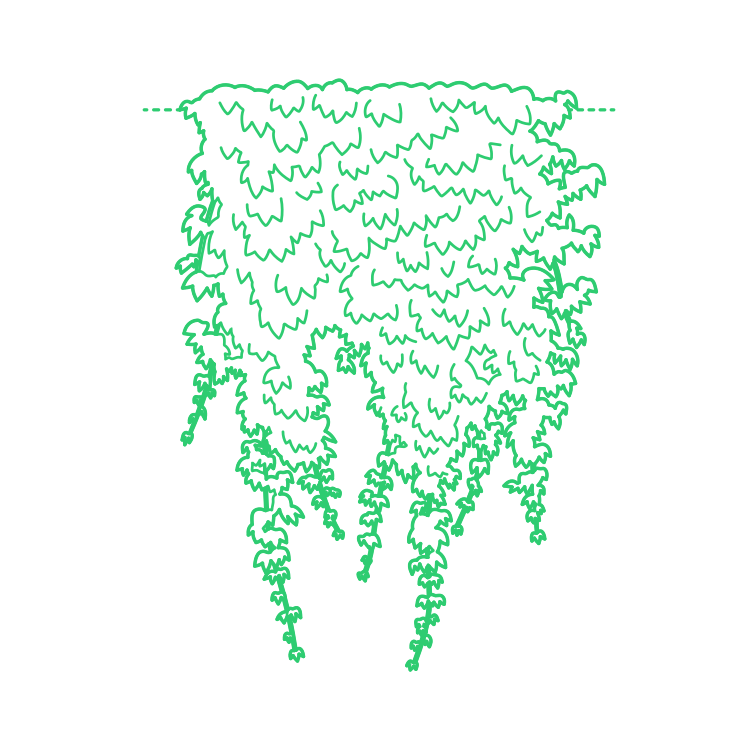
Wall-climbing vines are a group of flowering plants known for their ability to ascend vertical surfaces using various climbing mechanisms. Found naturally in forests, rocky slopes, and cliffs, these plants have adapted to seek sunlight by growing upward along trees, walls, or other structures.

Rammed earth masonry is an ancient construction technique that involves compacting a mixture of damp soil, clay, and sometimes stabilizers like lime or cement, in layers within wooden or metal formwork. When compressed, these layers form a dense, solid wall with distinct horizontal striations. Rammed Earth Walls are constructed with typical overall wall depths of 8”, 12”, 18”, 24” (20, 30.5, 46, 61 cm). Overall heights of Rammed Earth Walls are commonly between 8’-24’ (2.44-7.32 m) with wall lengths of 12’-32’ (3.66-9.75 m). Each layer of rammed earth has a thickness between 2.5”-6” (6-15 cm).

Outside corner steel walls, utilizing three C-Studs, are employed to construct strong and neat exterior angles in drywall framing. Two C-Studs meet perpendicularly, forming the structural backbone of the walls. A third C-Stud is then placed at the junction where these two C-Studs meet. Steel Wall Outside Corners are constructed with stud depths of 3.625”, 5.5” (9.2, 14 cm) and stud spacings of 12”, 16”, 24” (30.5, 40.6, 61 cm). Overall heights for Steel Walls are typically between 8’-12’ (2.44-3.66 m).

Channel steel wall headers employ U-shaped structural steel channels to span over openings in walls, such as windows and doors. These channels serve as the primary load-bearing elements, effectively distributing the weight from above. The U-shape inherently offers a convenient cavity for insulation. Channel Header Steel Walls have header heights of 3.63”, 5.5”, 7.5” (9.2, 14, 19.1 cm). Steel framed walls are typically constructed with stud depths of 3.625”, 5.5” (9.2, 14 cm) and stud spacings of 12”, 16”, 24” (30.5, 40.6, 61 cm).

L steel wall headers utilize L-shaped steel joists, which are positioned along the top track of wall openings such as windows and doors. The L-shaped profile provides structural support for the loads above the opening. When two L-shaped joists are used in tandem, they form a box configuration. L-Header Steel Walls have header heights of 3.63”, 5.5”, 7.5” (9.2, 14, 19.1 cm). Steel framed walls are typically constructed with stud depths of 3.625”, 5.5” (9.2, 14 cm) and stud spacings of 12”, 16”, 24” (30.5, 40.6, 61 cm).

The Mallhoppa Wall Clock by IKEA, has a modern, sleek look, keeping things simple without any numbers. Battery-powered, this clock is great for the home, office, or even bedroom offering a silent sleep with no annoying ticking sound. Silver with a white background, this clock can fit well anywhere. The IKEA Mallhoppa Wall Clock has an overall diameter of 13.78” (35 cm) and depth of 2.76” (7 cm).