Japanese Cheesewood (Tree, Small) (Pittosporum tobira)
Japanese Cheesewood (Tree, Small) (Pittosporum tobira)
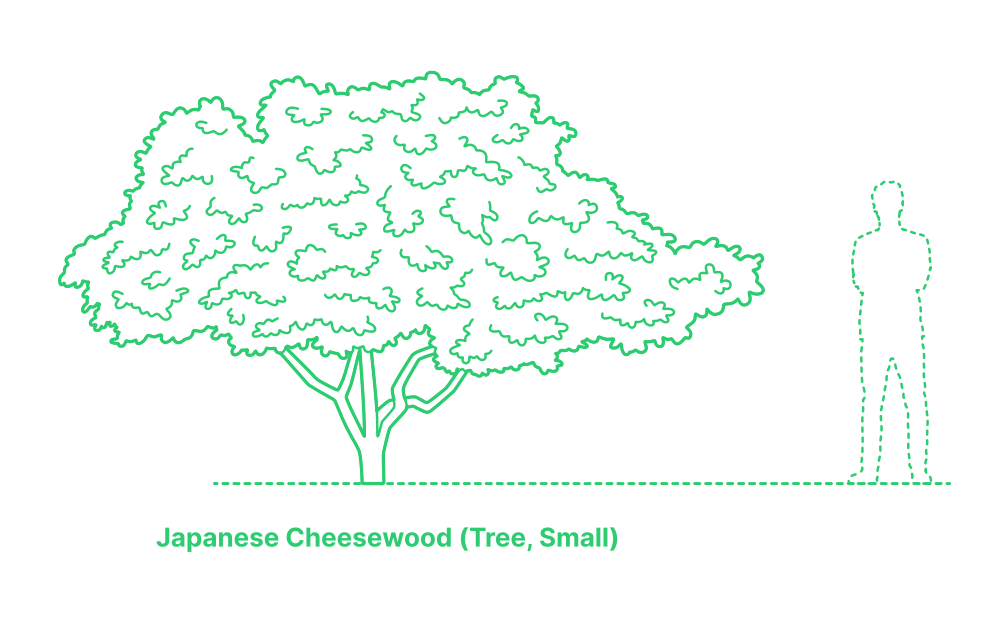

Japanese cheesewood (Pittosporum tobira) in a small form presents as a compact evergreen tree-like shrub with tightly layered branching and dense terminal foliage clusters. The leaves are smooth, leathery, and oval, growing in rosette-like arrangements at the ends of branches and producing a thick, structured canopy. Unlike broader mature forms, this smaller variation maintains a more condensed silhouette, emphasizing the plant’s naturally ordered branching geometry.
Native to coastal and woodland regions of Japan, China, and Korea, Pittosporum tobira thrives in temperate and subtropical environments where it is exposed to wind and seasonal moisture variation. The species is biologically notable for its waxy evergreen foliage and durable woody stems, which support year-round persistence. Small white flowers appear in clustered formations and emit a sweet fragrance before developing into rounded seed capsules. In its smaller expression, Pittosporum tobira highlights compact structure, dense foliage layering, and refined architectural form while retaining the species’ characteristic evergreen resilience.
Japanese Cheesewood (Tree, Small) has a typical overall height between 5’-10’ (1.52-3.05 m) and spread diameter of 8’-15’ (2.44-4.57 m). The leaves have a typical length between 2”-5” (5-13 cm).
Japanese cheesewood (Pittosporum tobira) in a small form presents as a compact evergreen tree-like shrub with tightly layered branching and dense terminal foliage clusters. The leaves are smooth, leathery, and oval, growing in rosette-like arrangements at the ends of branches and producing a thick, structured canopy. Unlike broader mature forms, this smaller variation maintains a more condensed silhouette, emphasizing the plant’s naturally ordered branching geometry.
Native to coastal and woodland regions of Japan, China, and Korea, Pittosporum tobira thrives in temperate and subtropical environments where it is exposed to wind and seasonal moisture variation. The species is biologically notable for its waxy evergreen foliage and durable woody stems, which support year-round persistence. Small white flowers appear in clustered formations and emit a sweet fragrance before developing into rounded seed capsules. In its smaller expression, Pittosporum tobira highlights compact structure, dense foliage layering, and refined architectural form while retaining the species’ characteristic evergreen resilience.
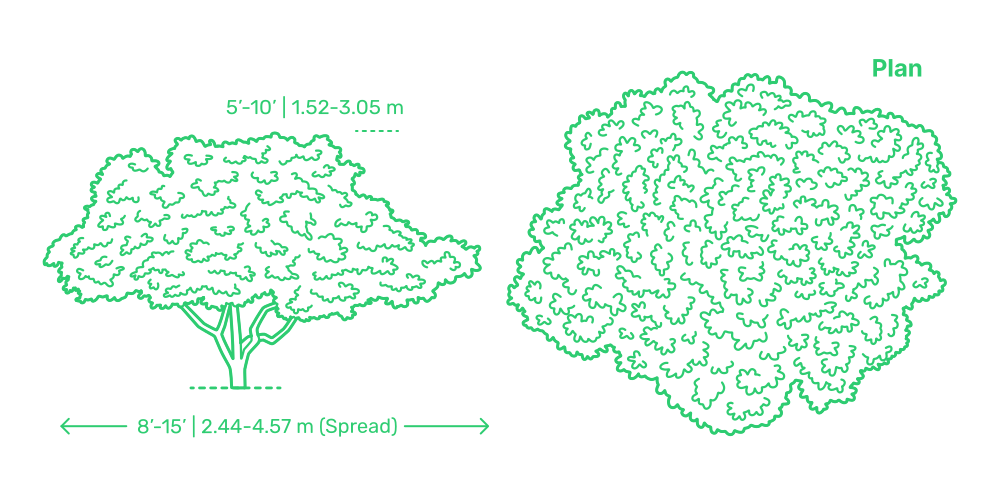
Japanese Cheesewood (Tree, Small) has a typical overall height between 5’-10’ (1.52-3.05 m) and spread diameter of 8’-15’ (2.44-4.57 m). The leaves have a typical length between 2”-5” (5-13 cm).