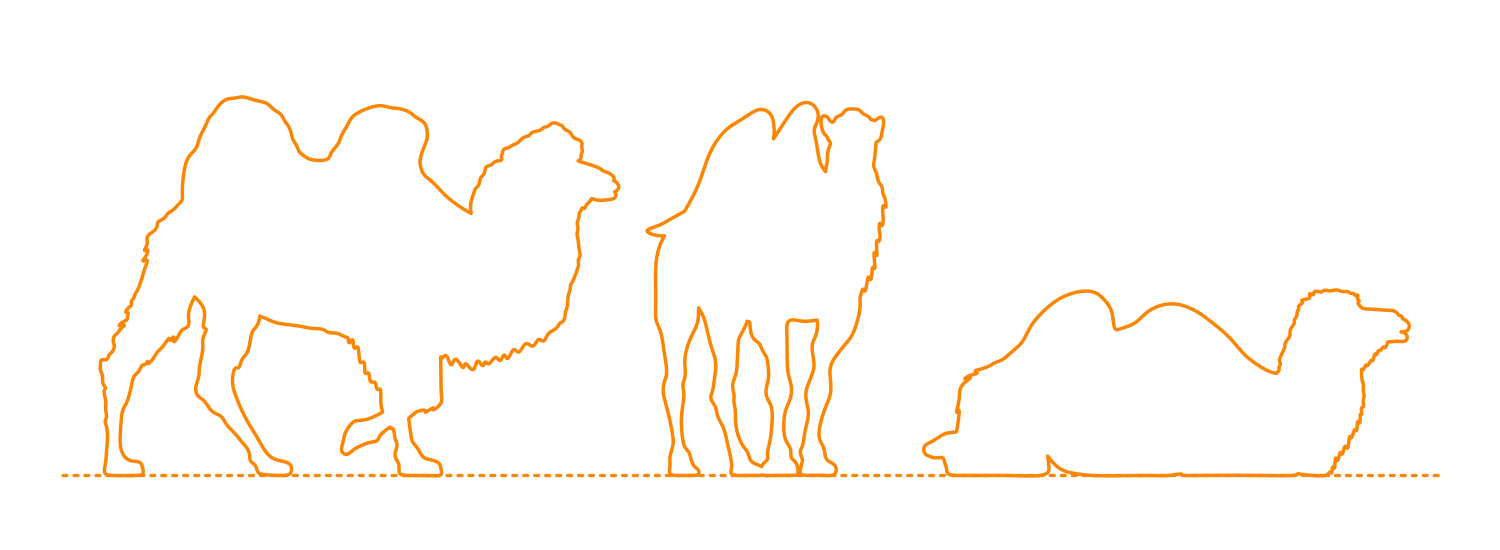
The Bactrian Camel is a two-humped camelid residing in the Central and Eastern Asian Desert and is closely related, but wholly distinct from, the Wild Bactrian Camel, Camelus ferus. With its tolerance for both hot and cold temperatures, adaptation for high altitudes, and endurance for many miles, the Bactrian Camel enabled trade along the Silk Road from 130 B.C. to 1453 A.D. as a versatile pack animal. While mostly domesticated, a small feral population still exists in southwest Kazakhstan and India. Similar to the Dromedary Camel, the Bactrian Camel rarely sweats, can close its nostrils to sand, and has two rows of eyelashes to protect his eyes.
The average Bactrian Camel has an overall height of 84" (7’) (2.13 m), withers height of 62"-71" (5’2”-5’11”) (157-180 cm), and body length of 89"-138" (7’5”-11’6”) (225-350 cm). A typical Bactrian Camel weighs between 990-1100 lb (450-500 kg) and has a lifespan of roughly 20-40 years; 50 (wild).

The Bactrian Camel is a two-humped camelid residing in the Central and Eastern Asian Desert and is closely related, but wholly distinct from, the Wild Bactrian Camel, Camelus ferus. With its tolerance for both hot and cold temperatures, adaptation for high altitudes, and endurance for many miles, the Bactrian Camel enabled trade along the Silk Road from 130 B.C. to 1453 A.D. as a versatile pack animal. While mostly domesticated, a small feral population still exists in southwest Kazakhstan and India. Similar to the Dromedary Camel, the Bactrian Camel rarely sweats, can close its nostrils to sand, and has two rows of eyelashes to protect his eyes.
The average Bactrian Camel has an overall height of 84" (7’) (2.13 m), withers height of 62"-71" (5’2”-5’11”) (157-180 cm), and body length of 89"-138" (7’5”-11’6”) (225-350 cm). A typical Bactrian Camel weighs between 990-1100 lb (450-500 kg) and has a lifespan of roughly 20-40 years; 50 (wild).